
Key Takeaways:
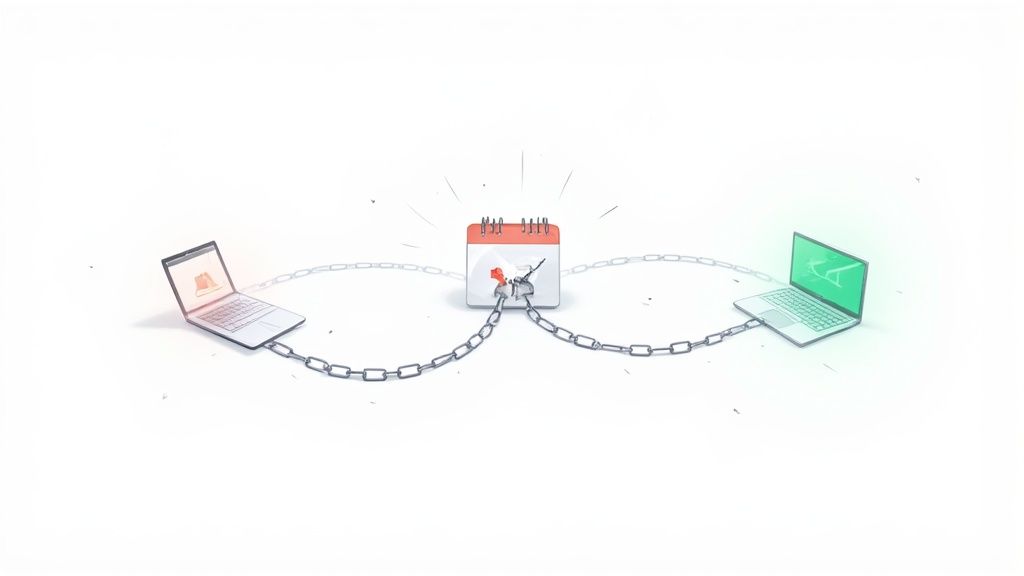
- Your calendar links might work perfectly in Gmail but fail silently for 60%+ of your audience using Outlook, Apple Mail, or Yahoo
- Click-through rates don't tell the full story - the real metric is whether events actually land on calendars
- Email clients strip interactive elements and mangle dynamic code, making most calendar buttons unreliable
- A hosted calendar page approach survives the rendering chaos across 50+ email environments
- Measuring calendar saves (not just clicks) reveals the true engagement picture
You tested your newsletter in Gmail. The calendar link worked perfectly. You clicked it, the event popped up, and you thought - nailed it.
Then the support tickets started rolling in.
"I clicked the button but nothing happened." "The calendar link just opens a blank page." "Works on my phone but not my laptop."
Sound familiar? Here's the uncomfortable truth about add to calendar links in email campaigns: what works in one email client will absolutely break in another. And you won't know it's happening until your attendance numbers tank.
📧 The Email Client Fragmentation Problem
Let's talk numbers. According to Litmus's email client market share data, the email world is split across dozens of clients - Gmail, Apple Mail, Outlook, Yahoo Mail, and countless others. Each one renders your carefully crafted email differently.
We're not talking about minor font variations here.
We're talking about fundamentally different rendering engines that treat your calendar button like a security threat.
Why Your Calendar Button Renders Differently Across 50+ Environments
| Email Client | Rendering Engine | Interactive Element Support | Calendar Link Behavior |
|---|---|---|---|
| Gmail (Web) | Custom | Limited | Usually works |
| Outlook 2019 (Windows) | Microsoft Word 😬 | Severely limited | Often breaks |
| Outlook (Mac) | WebKit | Moderate | Hit or miss |
| Apple Mail | WebKit | Good | Generally reliable |
| Yahoo Mail | Custom | Limited | Inconsistent |
| Mobile clients | Varies wildly | Unpredictable | Chaos |
Yes, you read that right. Outlook for Windows uses Microsoft Word as its rendering engine. According to enterprise email research, this creates a situation where a single email can display in up to 15,000 different ways depending on how it's rendered.
15,000 ways. And your calendar link needs to work in all of them.
How Mailchimp and HubSpot Templates Handle Calendar Functionality
Here's the deal: platforms like Mailchimp and HubSpot give you beautiful templates. Gorgeous drag-and-drop editors. Seamless workflows.
But when it comes to calendar integration? They're mostly passing the problem to you.
HubSpot's documentation recommends multiple methods - Google Calendar links, .ics files, meeting tools - and emphasizes testing across different platforms. The emphasis on testing exists because they know things break.
The silent failure mode is the worst part. Clicks register in your analytics. Your CTR looks healthy. But calendars stay empty.
💔 The Hidden Cost of Broken Calendar Links
"What gets measured gets managed." - Peter Drucker
But what about what doesn't get measured?
Your email analytics dashboard shows impressive numbers:
- Open rate: 42%
- Click-through rate: 8.3%
- Calendar button clicks: 247
Looks great, right? Except here's what you're not seeing: the gap between clicks and actual calendar saves. That 247 clicks might translate to 90 actual calendar entries. Maybe fewer.
The Gap Between 'Clicked' and 'Actually Saved to Calendar'
Consider the journey your subscriber takes:
- ✅ Opens email
- ✅ Clicks calendar button
- ❓ Redirect happens (maybe)
- ❓ Calendar app opens (hopefully)
- ❓ Event details populate correctly (fingers crossed)
- ❓ User confirms and saves (if they haven't given up)
Every step is a potential failure point. And email clients introduce their own chaos at step 3.
Why Your Open Rates Might Be Lying About Real Commitment
Apple's Mail Privacy Protection has thrown another wrench into the machine. Since 2021, Apple Mail users can disable open tracking entirely - which means your "42% open rate" might be inflated by phantom opens that never actually happened.
The only metric that tells you someone is actually committed to attending? Whether they saved the event to their calendar. That's calendar saves as the leading indicator of attendance - and most email marketers aren't tracking it at all.
Real Metrics: Calendar Save Failures and Attendance Drop-off
Here's what the data shows:
- 40-60% of free event registrants no-show
- Calendar saves create psychological micro-commitment
- Show-up rates increase by 86% when events are actually saved to calendars
Your broken calendar links aren't just a UX problem. They're directly causing your no-show epidemic.
🛠️ What Actually Works Inside Email Client Sandboxes
Email clients operate like paranoid security guards. They strip JavaScript. They mangle CSS. They block external resources. They do everything possible to protect users from malicious code.
Unfortunately, your clever calendar integration looks exactly like malicious code to these systems.
The Anatomy of Calendar Links That Survive Rendering Engines
Let's break down your options:
Option 1: ICS File Attachments
- ✅ Universal compatibility
- ❌ Spam filter triggers
- ❌ No update capability
- ❌ Feels clunky to users
Option 2: Deep Links (google.com/calendar/event)
- ✅ Works for Gmail users
- ❌ Fails for Outlook/Apple Calendar users
- ❌ Requires separate links per platform
Option 3: Hosted Calendar Pages
- ✅ Survives all rendering engines
- ✅ Works across all email clients
- ✅ Single link, multiple calendar options
- ✅ Trackable saves, not just clicks
Why Dynamic Content Gets Stripped and Static Links Persist
Understanding why calendar buttons fail across email clients comes down to one principle: email clients trust URLs to external pages. They don't trust code that runs inside the email.
A simple <a href="https://yourpage.com/add-event"> survives the rendering gauntlet.
A JavaScript-powered inline calendar widget? Dead on arrival.
The Mobile-First Reality Most Email Marketers Ignore
Here's something most email marketers forget: over 60% of email opens happen on mobile devices. Your calendar link needs to:
- Load quickly on cellular connections
- Detect the user's calendar app preference
- Handle timezone conversions automatically
- Work with one thumb tap
Building this yourself? That's weeks of develpoment time. And you'll still miss edge cases.
🚀 Building Calendar Buttons That Convert Across Clients
So what's the actual solution?
"Simplicity is the ultimate sophistication." - Leonardo da Vinci
The answer isn't more complex email code. It's simpler links that point to smarter pages.
How Add to Calendar PRO Generates Email-Safe Links
Add to Calendar PRO takes a fundamentally different approach. Instead of trying to make inline calendar functionality work (spoiler: it won't), it generates hosted calendar pages that:
- Work with a single link in any email client
- Auto-detect the user's preferred calendar (Google, Apple, Outlook, etc.)
- Handle timezone conversion without user input
- Track actual calendar saves - not just page visits
The email client doesn't need to render anything complex. It just needs to follow a standard link. Easy.
Testing Methodology for Cross-Client Calendar Compatibility
If you're serious about calendar engagement, here's your testing checklist:
| Test | Why It Matters |
|---|---|
| Gmail (Web + Mobile) | Largest market share |
| Outlook (Windows + Mac + Web) | Different rendering engines |
| Apple Mail (Desktop + iOS) | Mail Privacy Protection impact |
| Yahoo Mail | Still has significant users |
| Samsung Email | Android default on many devices |
| Dark mode variants | Can break visual elements |
The One-Click Experience vs Multi-Step Reality
Users expect: Click button → Event appears in calendar.
Users often get: Click button → New tab opens → Choose calendar app → Confirm details → Save.
Every extra step loses users. The goal is reducing that journey to absolute minimum friction.
Measuring Actual Calendar Saves Instead of Just Clicks
This is where most email marketers drop the ball. They celebrate click-through rates while remaining blind to what happens next.
With Add to Calendar PRO, you get actual save tracking. You know:
- How many people clicked
- How many actually saved to their calendar
- Which calendar platforms they prefer
- Your true "calendar commit rate"
This data transforms how you understand engagement. It's the differnce between measuring intent and measuring commitment.
📊 The Numbers That Actually Matter
| Metric | What Email Analytics Shows | What You Actually Need |
|---|---|---|
| Opens | Inflated (MPP issues) | Directional only |
| Clicks | Button was pressed | ✅ Useful but incomplete |
| Calendar Saves | Usually invisible | ✅ True commitment signal |
| Attendance | Post-event only | Predicted by saves |
Your newsletter engagement metrics are incomplete without calendar save data. Period.
✅ Conclusion: The Fix Is Simpler Than Rebuilding Your Templates
You don't need to overhaul your Mailchimp or HubSpot workflow. You don't need to code custom calendar integrations for every email client.
You need calendar links that actually work. Everywhere.
Add to Calendar PRO generates email-safe links that survive the rendering chaos across Gmail, Outlook, Apple Mail, Yahoo, and every other client your subscribers use. One link. Every calendar platform. Trackable saves.
Stop celebrating CTR on calendar buttons that lead nowhere. Start measuring what matters - actual calendar saves that predict actual attendance.
Becuase the link that "worked in Gmail" isn't working for your business if half your audience can't use it.
Ready to see your real calendar engagement numbers? Your next newsletter campaign deserves buttons that work - everywhere.